
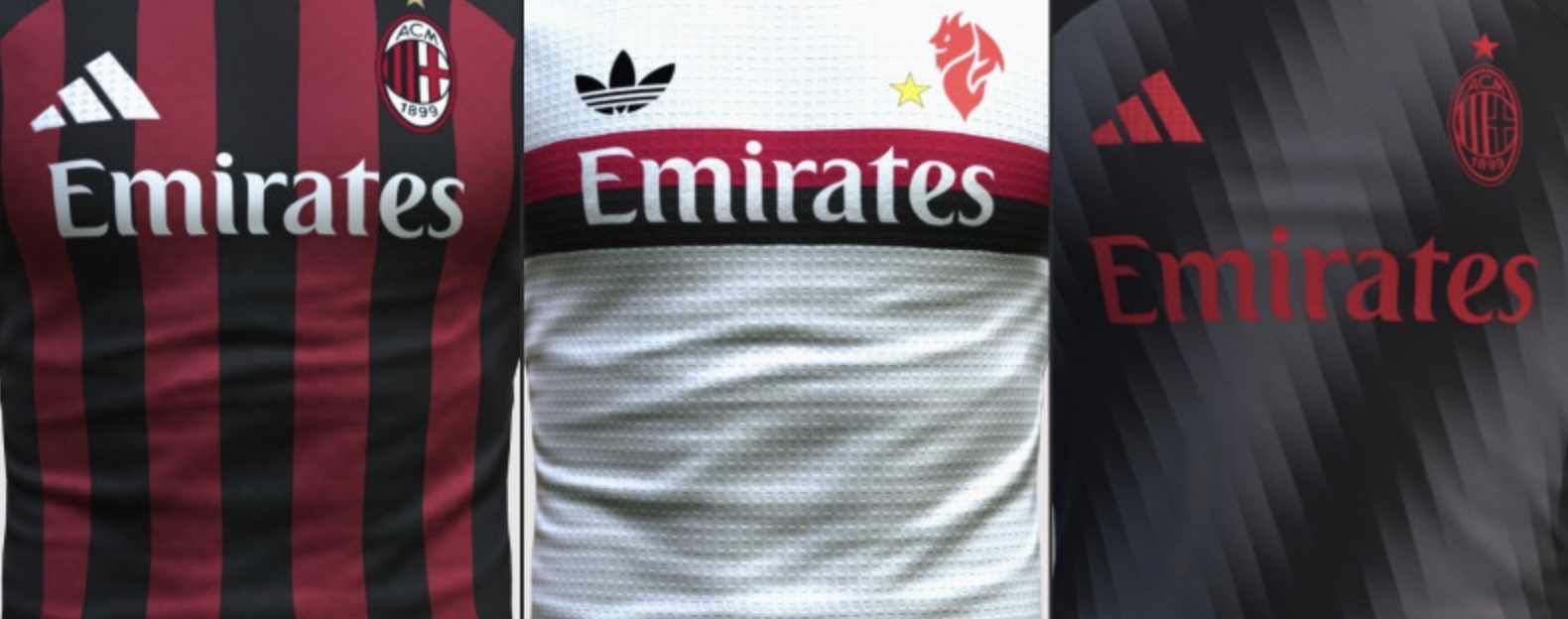
November 6 – AC Milan will switch back to Adidas from summer 2028 in a 10-year deal worth around $56 million a season, making it one of the most lucrative kit agreements in Italian football history.
The figure marks a huge jump. Milan signed with Puma a decade ago for around $15.7 million a year, and that deal was renewed in 2022 at roughly $33.6 million per season. The new agreement adds more than $20 million a year to the club’s income and changes the value of the Milan shirt significantly.
It is also a homecoming. Adidas supplied Milan in the 1970s, the early 1990s and then for two decades from 1998 to 2018, including the Champions League-winning sides of 2003 and 2007.
For RedBird Capital Partners, the club’s owner, the deal is a major boost. Milan reported a €24 million loss last season after missing out on European football, despite record sponsorship income, and kit deals are among the most reliable long-term revenue streams a club can secure. A 10-year commitment gives the club certainty as it pursues the new San Siro project with Inter.
The deal adds to a strong period for Adidas in Italy. It already supplies the national team, Juventus (€40 million per year) and Roma, and is reported to be replacing Puma as Serie A’s official ball supplier from 2027-28.
For Puma, losing one of its flagship clubs is a setback. Milan has been among its most visible properties in European football, and the move comes in the same week reports suggested it would also lose the Serie A ball contract.
Contact the writer of this story at [email protected]
PakarPBN
A Private Blog Network (PBN) is a collection of websites that are controlled by a single individual or organization and used primarily to build backlinks to a “money site” in order to influence its ranking in search engines such as Google. The core idea behind a PBN is based on the importance of backlinks in Google’s ranking algorithm. Since Google views backlinks as signals of authority and trust, some website owners attempt to artificially create these signals through a controlled network of sites.
In a typical PBN setup, the owner acquires expired or aged domains that already have existing authority, backlinks, and history. These domains are rebuilt with new content and hosted separately, often using different IP addresses, hosting providers, themes, and ownership details to make them appear unrelated. Within the content published on these sites, links are strategically placed that point to the main website the owner wants to rank higher. By doing this, the owner attempts to pass link equity (also known as “link juice”) from the PBN sites to the target website.
The purpose of a PBN is to give the impression that the target website is naturally earning links from multiple independent sources. If done effectively, this can temporarily improve keyword rankings, increase organic visibility, and drive more traffic from search results.